1700h, September 5th, 2024
The most sacred pilgrimages are done on foot; look at history! Guru Nanak covered over 28,000 kilometres on foot. The Char Dhams are around 1600-1800 kilometres apart on foot. Are we on some holy pilgrimage when we run large distances? As I packed my final bags for the intermediate layering points, my mind was overflowing with these thoughts. Many prominent religious sites, such as Vaishno Devi in Katra, Badrinath, and Hemkund in Uttarakhand, are located at high altitudes that demand some effort to reach. People, regardless of their physical or economic status, strive tirelessly to get there. Why? Out of devotion? To find inner peace? Self discovery? Looking for a miracle? There won’t be a single answer!
1845h
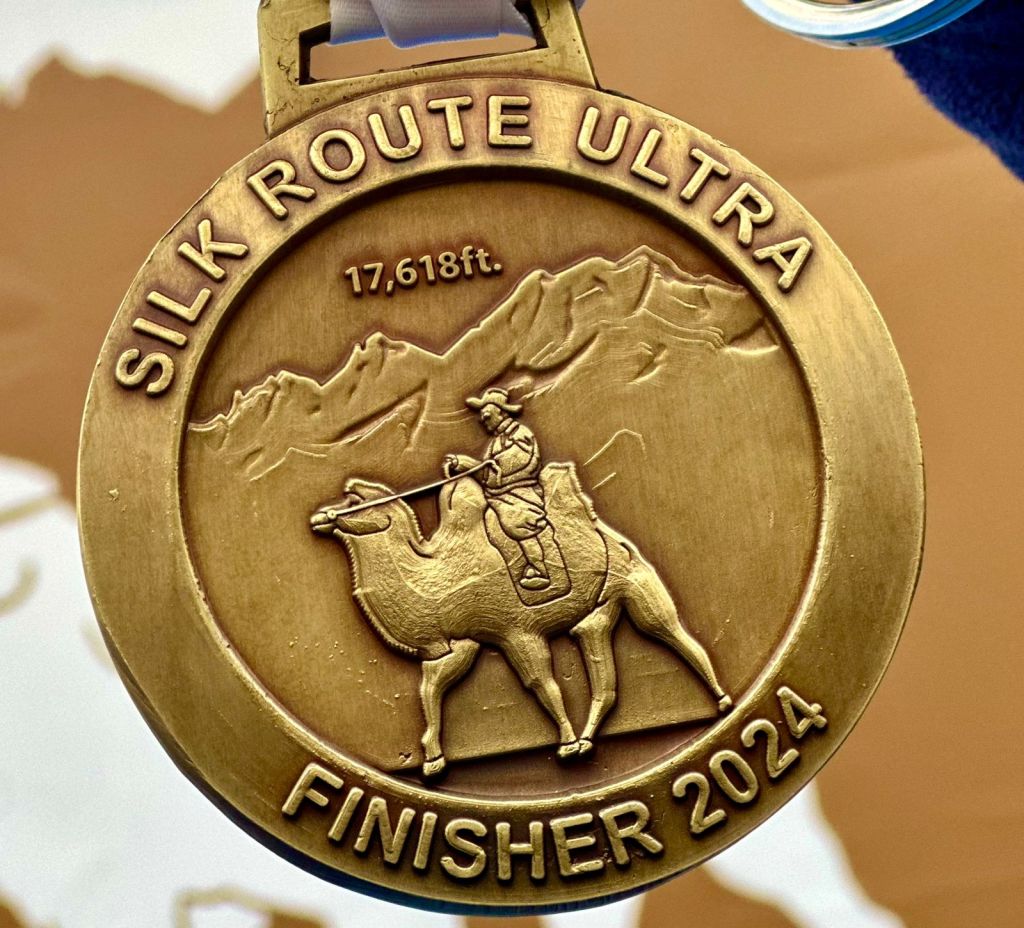
While I sought answers to such questions, my journey on foot would begin in 15 minutes: a 122- kilometre Silk Route Ultra (SRU) across the Khardung La (17,600 feet) alongside 65 other runners. Would it be a pilgrimage or just another run? I was not sure yet, and surely everyone else was in the same situation as me, looking for answers!
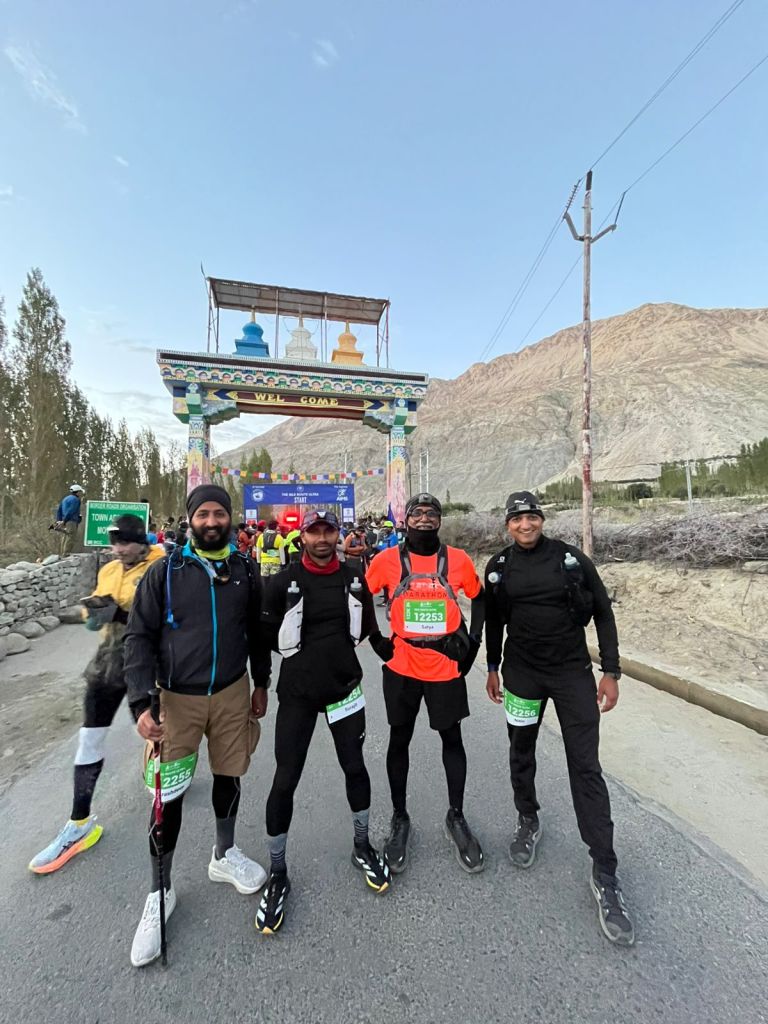
The atmosphere was lively in this small village of Khyger (10,300 feet), which is also the abode of the Tiger of Ladakh, Col. Chhewang Rinchen MVC, and Bar, Sena Medal. The runners, decked out in vibrant outfits and swanky equipment, were finalising their preparations. Everyone appeared to be jovial, yet there was an undercurrent of anxiety! The fear of the unknown! Easily seen through one’s eyes! The journey would be arduous!
1900h
The pistol went off to signal the start of the race. I remembered the Khardung La Challenge (KC) finish line from last year. Lying weary and depleted at the medical aid station, I resolved not to repeat such foolishness. The idiocy of running straight for over 11 hours and crossing Khardung La at 17,600 feet. But, as they say, suffering is the most powerful motivator for a runner. Blame it on the runner’s high or the drive to push physical bounds even further—“The mind, in other words, frames the outer limits of what we believe is humanly possible.” Whatever it was, the endo-cannabinoids had their say, and here I was again, sprinting along the historic Silk Road.
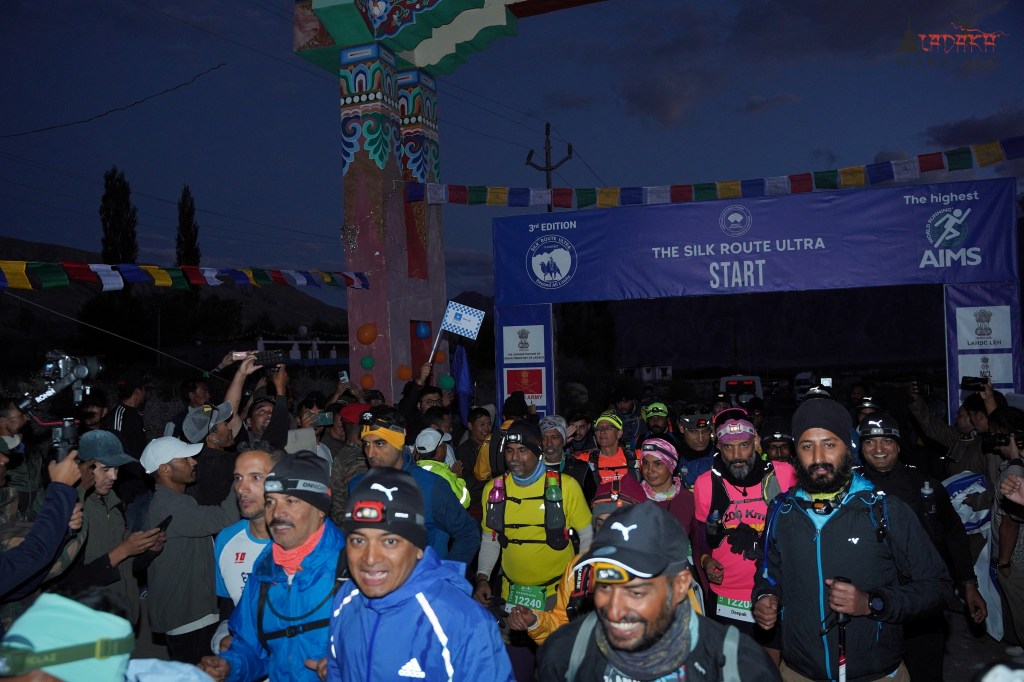
The first few km were spent warming up and adjusting the pace. The village teenagers ran alongside for a couple of miles. After that, it was a lonely run through the pitch-black night. The route was mostly flat, with a few uphill sections. There were a few villages in between, with residents cheering and motivating each runner and offering warm beverages, bananas, and homemade food.
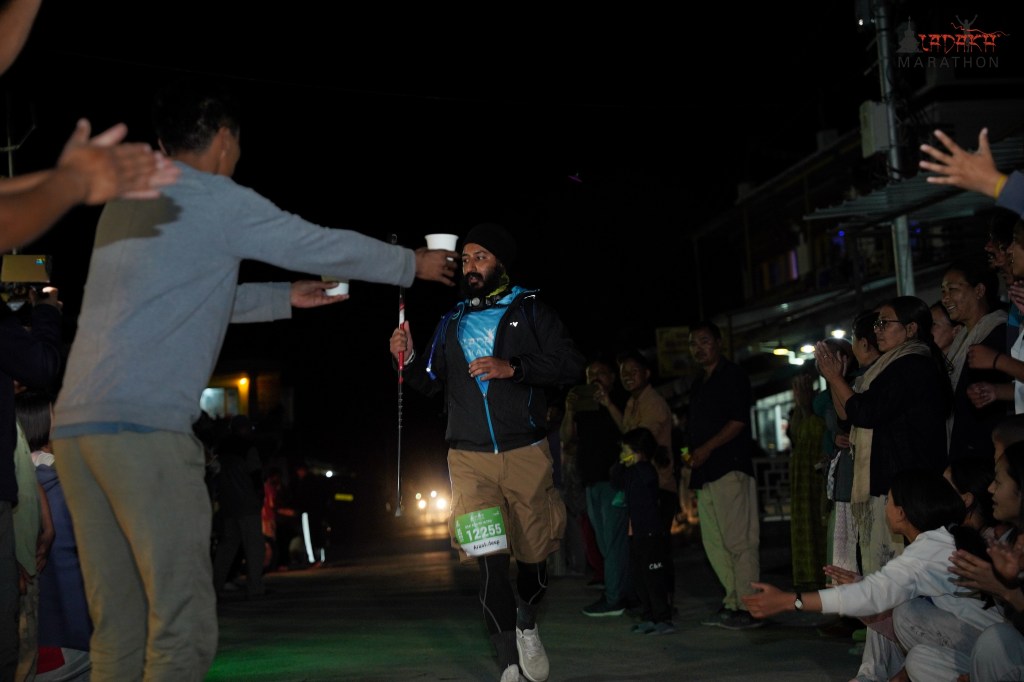
03 hours, 29 minutes, and 45 seconds; 27.6 km
I arrived at the first checkpoint at about 10:30 PM, thirty minutes before the cutoff. The aid station provided delicious hot tea and snacks. So far, the altitude gain has been negligible, and the next 54 kilometres will be a straight ascent up to the K top, with an estimated height gain of more than 8,000 feet. I had planned things, but I had never in my life faced so much self-doubt about how to approach them. This race has a success rate of less than 50%, and many runners have called it quit in this very next stretch.
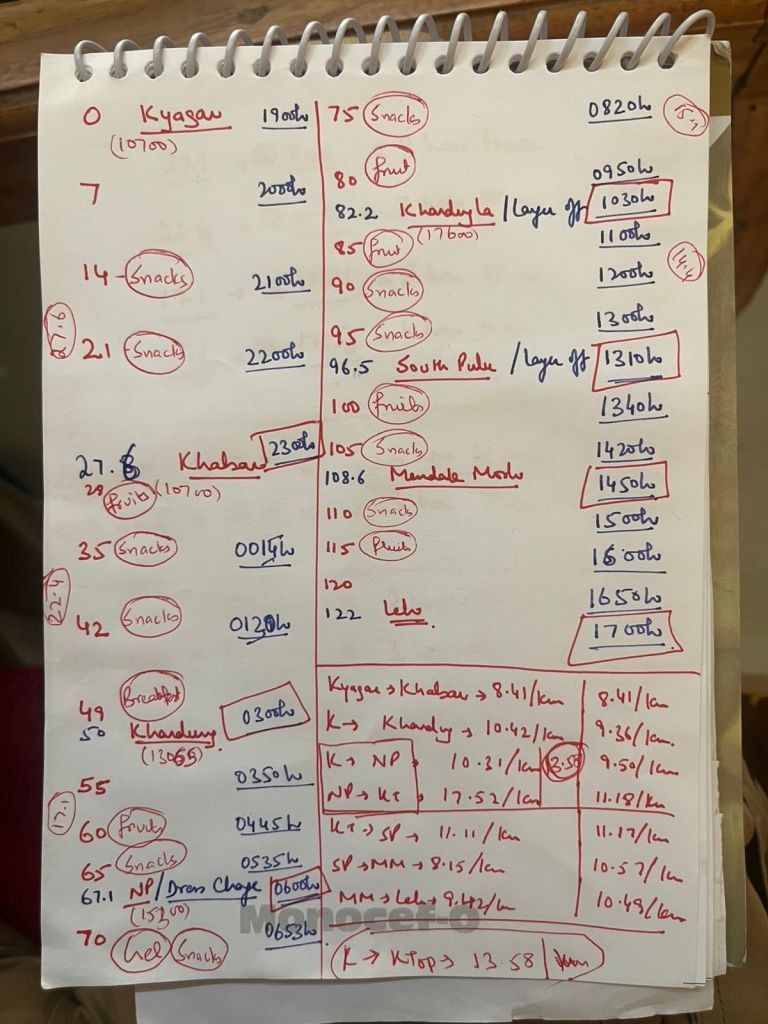
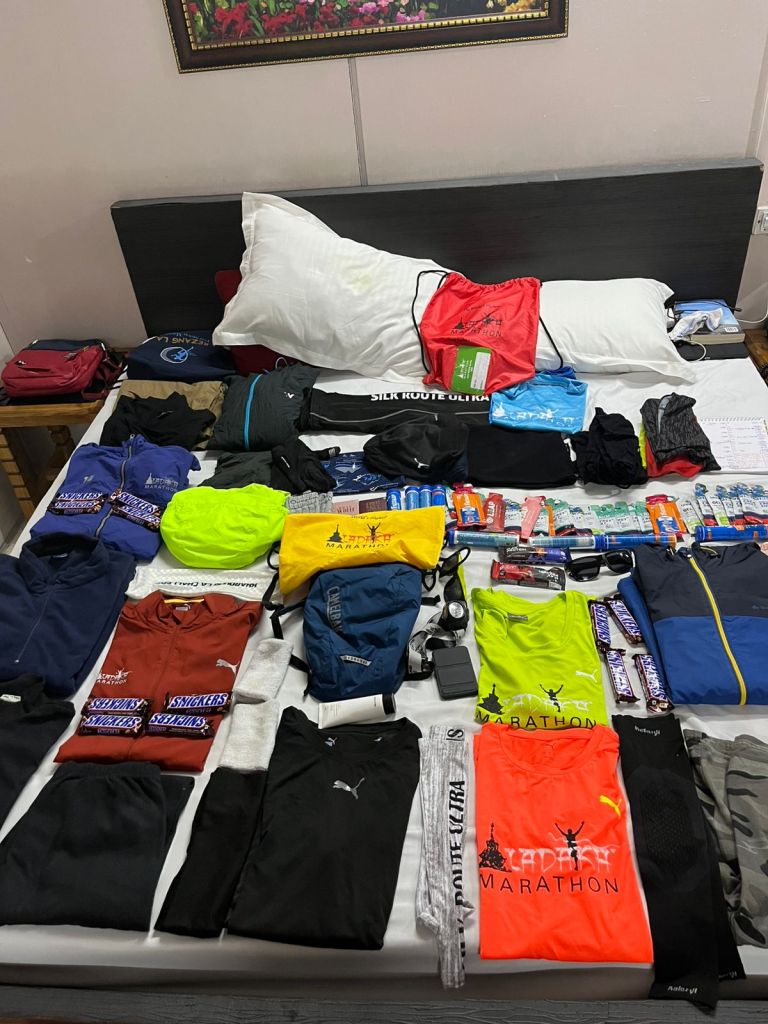
Nonetheless, I began the ascent. I intended to do a run-walk-run till I reached a height of 13,500 feet, as I was acclimatised to that altitude. But the first casualty of battle is always the plan, and I soon realised that running was out of the question. It was primarily due to the approximately ten-kilometre stretch of under construction road and partly due to the exhaustion from running the initial stretch of 28 km. Moving along a gravel and sand route was excruciatingly unpleasant. Thankfully, I figured out the pace and determined that I needed to walk at a pace of less than 10 minutes per kilometre to reach the next cutoff point on time. It was simple math, but easier said than done.
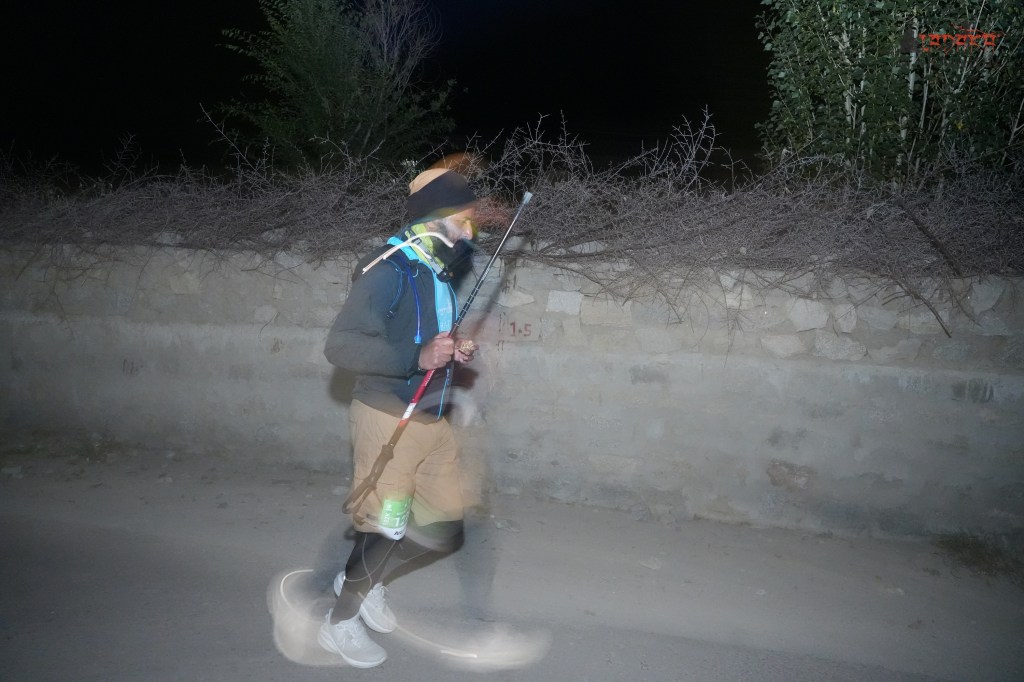
A few kilometres later, I was isolated from everyone in front and behind. The midnight stars were all over the sky, and the dark shadow of the Shyok River could be seen far away. The overhanging shadows of loose boulders on one side, a deep gorge on the other, and in between I was wandering in pure desolation, with sleep signals beginning to pour in. That stretch really tested my nerves. It felt like an endless stretch, and just as I was about to lose hope, the brightly illuminated Khardung town appeared on the horizon, illuminating my dimming spirit. It was still nine kilometre to the settlement, but the hard top road and less incline made it easier to traverse.
07 hours, 28 minutes, and 19 seconds; 50 km
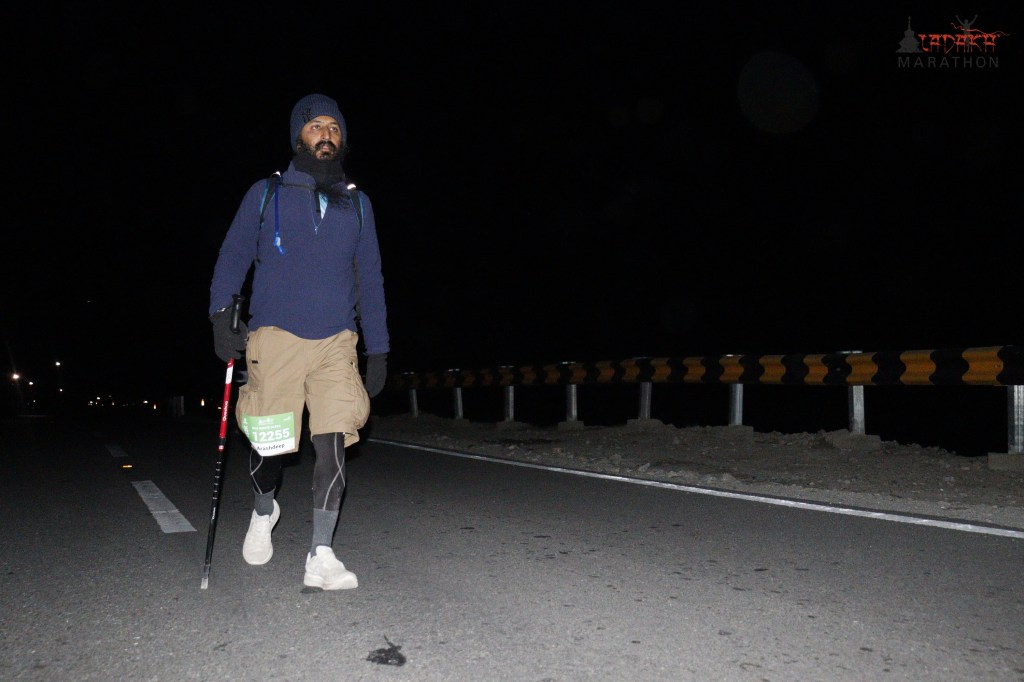
I arrived in Khardung at an altitude of 13,050 feet at about 02:30 AM, more than a half-hour ahead of the time limit. I was tired but comfortable. Boiling eggs, hot tea, and porridge were served for breakfast. Khardung is also the starting point for the Khardungla Challenge (KC), which will begin in another half hour. Looking at the KC contestants getting ready, I pondered why the organisers had made the already rigorous SRU tougher by shortening the cutoff timings! My sleep-deprived and hypoxic brain concluded that SRU is destined to be lost. With this wonderful notion in my mind, I continued my journey to North Pulu.
12 hours, 14 minutes, and 21 seconds; 76 km
TikTok, TikTok! An imaginary nagging sound kept echoing in the back of my head. The eyes were swirling like an ocean of bright colours being twisted. I headed into a halo with legs as heavy as a wood log, as if passing through marshes. The world around began to shake suddenly, and an oracle muttered, “Are you alright?”
The sun was out in its full glory. The oracle was the volunteer at the aid station who shook me from my slumber. I stopped here for refreshments and fell asleep while eating the pie. I held a cup of coffee in one hand and a half-eaten sandwich in the other. A bunch of runners passed by, catching their breath and taking one stride at a time. I looked at my watch. 16,458 feet, 76.8 km, and 07:14 AM. How long had I been out? I asked that guy, who smiled and replied, “Not for so long!”
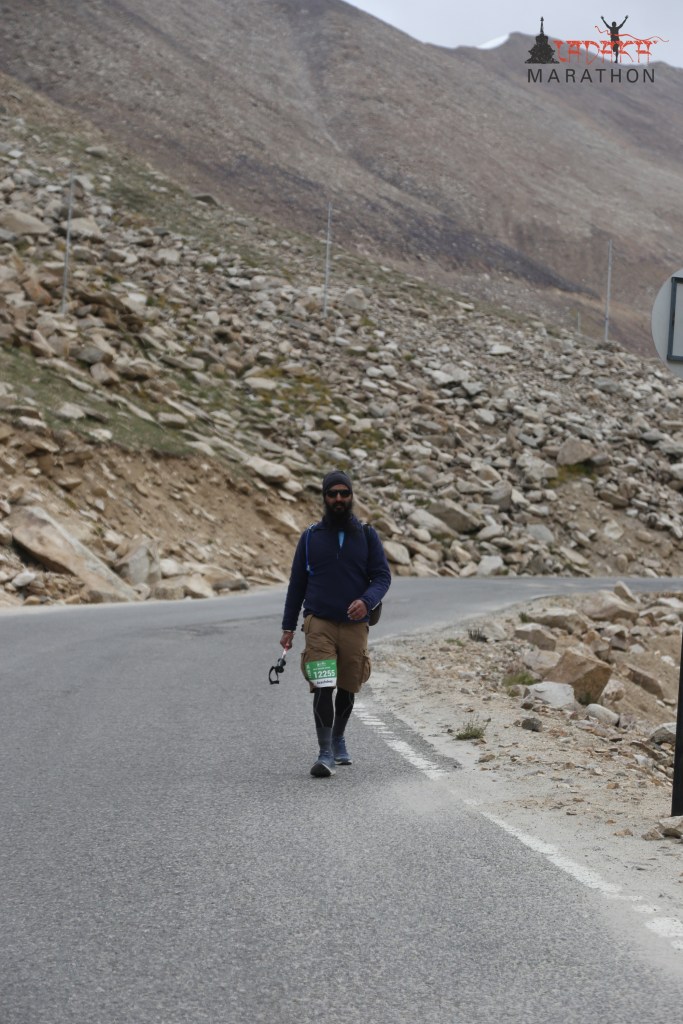
Since Khardung village, I had gained 3000 feet of altitude in approximately five hours, passing through North Pulu and remembering having a cup of tea there. More than 12 hours have passed since the start of this journey, and K-top is still 6 km away! Hypoxia and tiredness were playing tricks on my psyche, and even though my body was not yet completely exhausted, with less than 50% oxygen in the air, I had no resolve to move. All I wanted was to sleep forever!
14 hours, 52 minutes, and 22 seconds; 82.2 km
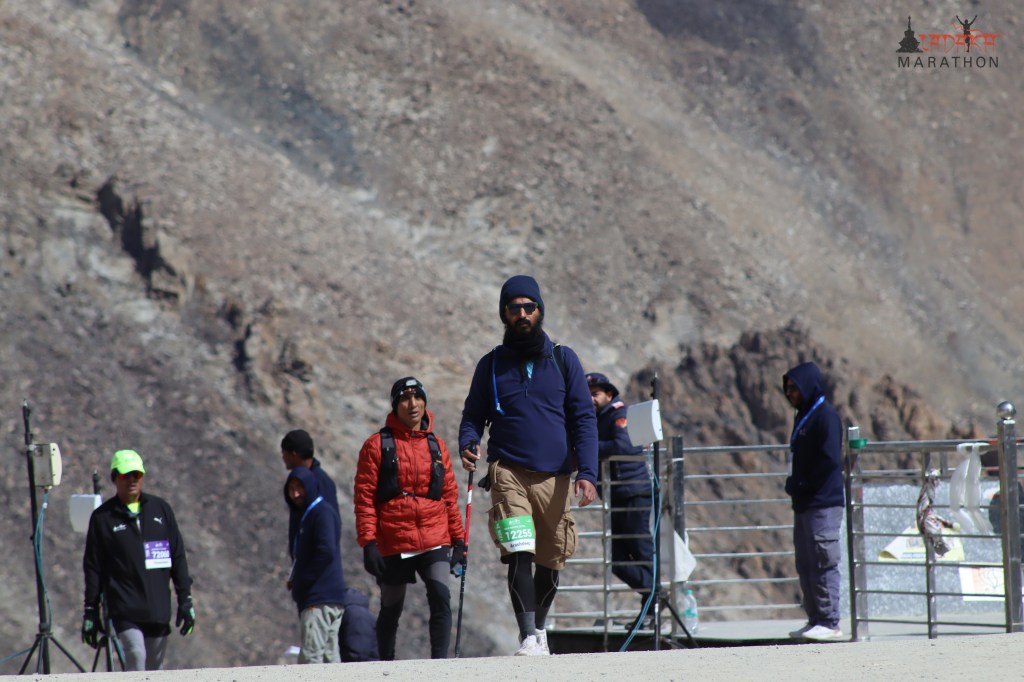
The cerebral cortex was shut down, and spinal reflexes had taken over. The body moved like a zombie, with the brain numb and eyes refusing to open, but success is “the struggle to continue against a mounting desire to stop.” After pushing and dragging myself one step at a time, I finally finished the six kilometers that seemed to go on forever. The timing mat acknowledged my arrival by bleeping twice as it registered the signal from the chip on my bib, and I stood at Khardung La, 17,600 feet, at 09:52 AM. There remained another 38 minutes until the cutoff. The first time I felt convinced that I could finish this race. The spectacular Stok mountain ranges on the opposite side were all smiling! Though wittily!
Descent
Wittily! Because just when you think you’ve completed the most daunting task, the next hurdle knocks you off guard. The nightly voyage had now lasted 15 hours, and the body had used all of its resources. It only wanted me to stop and rest, which was not an option at the time. Anyway, I started the descent slowly. The next, appropriately scheduled cutoff was at South Pulu, 14 kilometres away. I believed I’d be able to cover the distance easily now, but I soon understood that wasn’t the case.
It was because the following stop after South Pulu was Mendak Morh, which would have required me to essentially dash if I were to complete it within the time limit. I didn’t want that situation to arise since I wouldn’t be able to sustain that pace. The only option left was to go for a run walk run now, save some time, and get to South Pulu early.
So, after walking for about five-odd kilometres, I changed gears and began to jog again. Oh my goodness, the legs actually refused to move! It seemed as if my weight had suddenly doubled. Probably the accumulated lactate! Fortunately, after a few agonising miles as the lactate cleared, the body adjusted to the new dynamics, and running became a little more comfortable.
17 hours, 40 minutes, and 39 seconds; 96.5 km
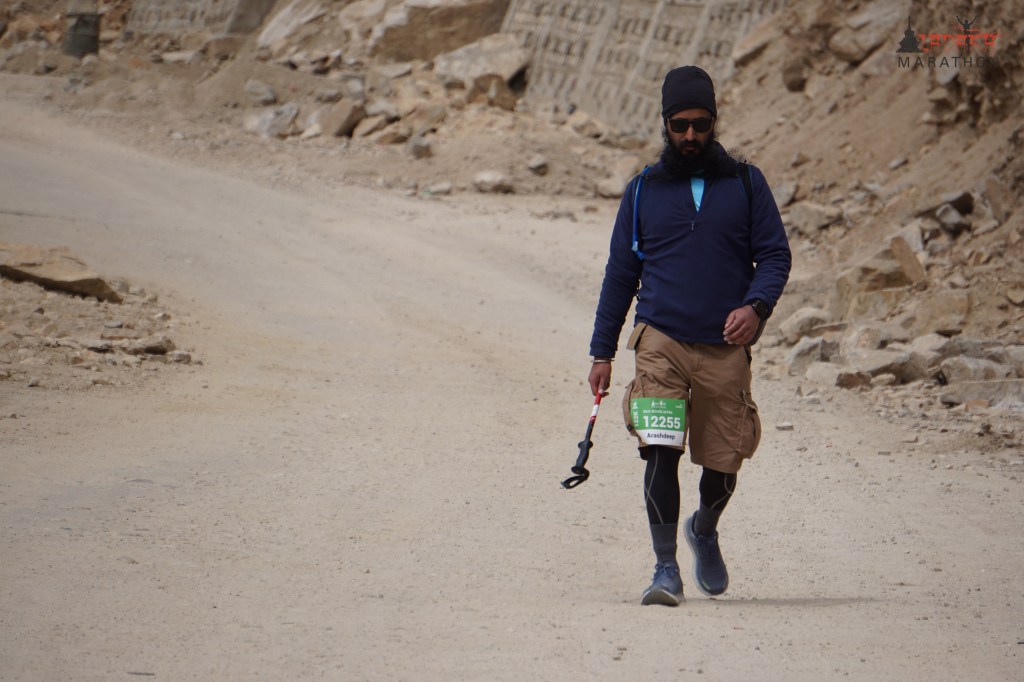
I crossed the South Pulu at 12:40 PM and saved an additional 30 minutes. But the extra running effort drained my body of any remaining energy. I’d already descended more than 2,000 feet from the top of Khardung La, yet my brain was still numb and acting strangely. I got a weird feeling of feeling nothing. My reflexes had slowed. The digital clock on my wrist seemed to move slowly. It took some effort for me to register time on my watch. I needed to keep up a pace to meet the next deadline, but I couldn’t do any calculations. I’d never felt this way before in my life. Psychomotor retardation! Anhedonia! I was entangled in a perpetual loop. But the “desire to finish” persisted in the limbic system, which kept me moving. Thankfully, Mendak Morh came ten minutes before the time was up.
19 hours, 36 minutes, and 14 seconds; 108 km
The finish point is now 13 km away. After crossing Mendak Morh at 02:36 PM, I stopped at the next aid station for a cup of coffee. I began to feel better and refreshed. Whether it was the coffee, the lower altitude, or the approaching finish line, it felt like my brain got reactivated. I could comprehend my surroundings. The wristwatch now appeared to function normally. “Ultra run is 80% mental; the remaining 20% is also mental. Once you have survived the first 80%, the mind and body function in surprising ways to complete the remaining 20%!“
As I approached the finish line, I remembered KC’s triumph last year. Then I recalled the first DNF from the Narkanda trail run! I kept running till the “7 km to go” board showed up. How badly did I do at the Delhi Marathon in February, followed by the Shauryathon in Kargil, where I had horrible cramps? I wondered. Then came the satisfying success of the Hampta Pass summit trail run. All of these were training runs for the ultimate race. Preparing for this marathon at 13,000 feet was no less challenging. All those sleepless nights and early morning headaches! The thought of getting a deadly illness like HAPO or CVT! A fear of collapsing at night! The mere thought of those sent shivers down the spine!
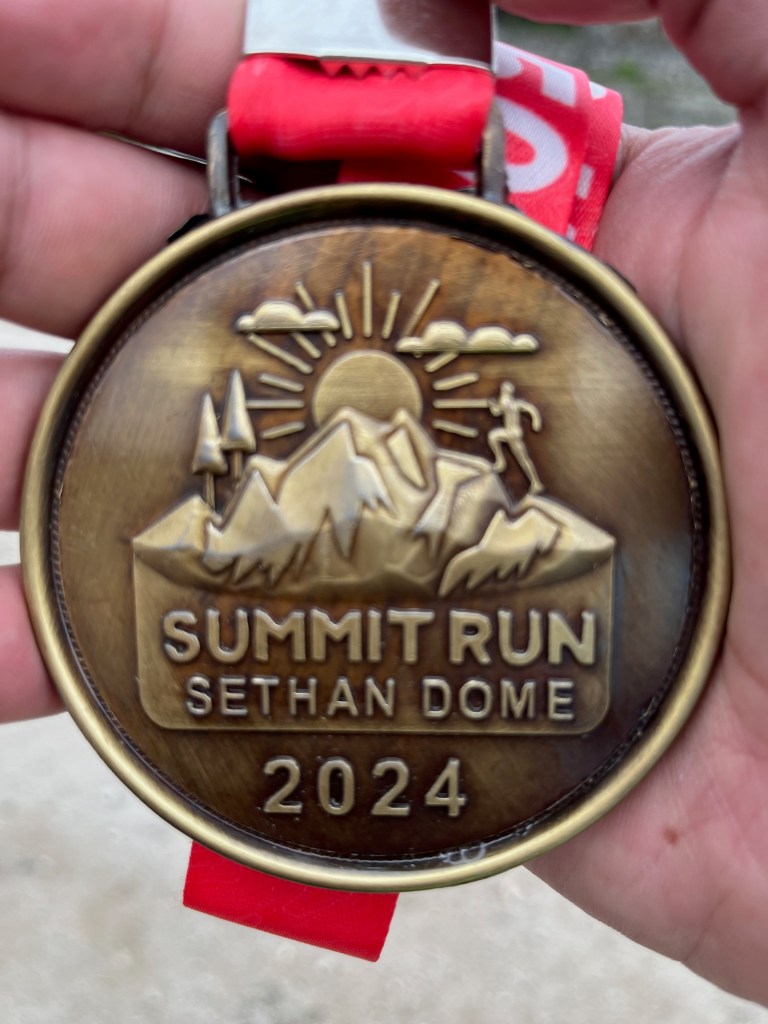
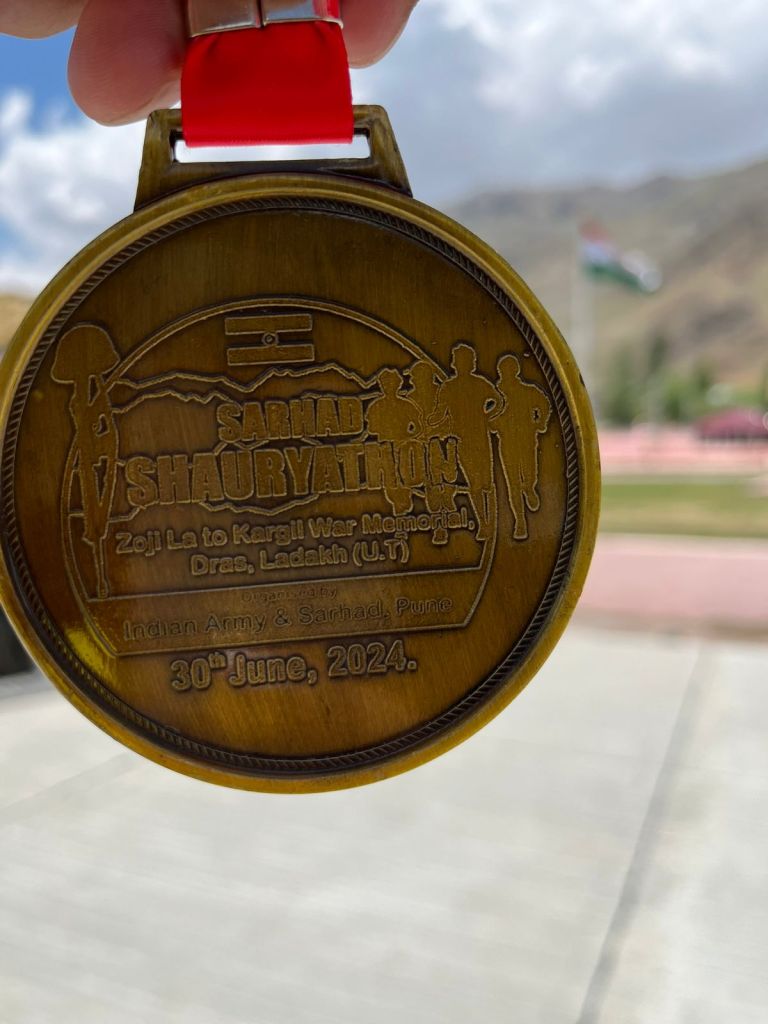
As I entered the narrow streets in Leh town, I could see that my nearly 750 km of training in high altitude, which included more than 13,000 m of cumulative height gain, was paying off. “After all, running is the greatest metaphor for life, you get out of it, what you put in it!“
21 hours, 43 minutes, and 20 seconds; 122 km
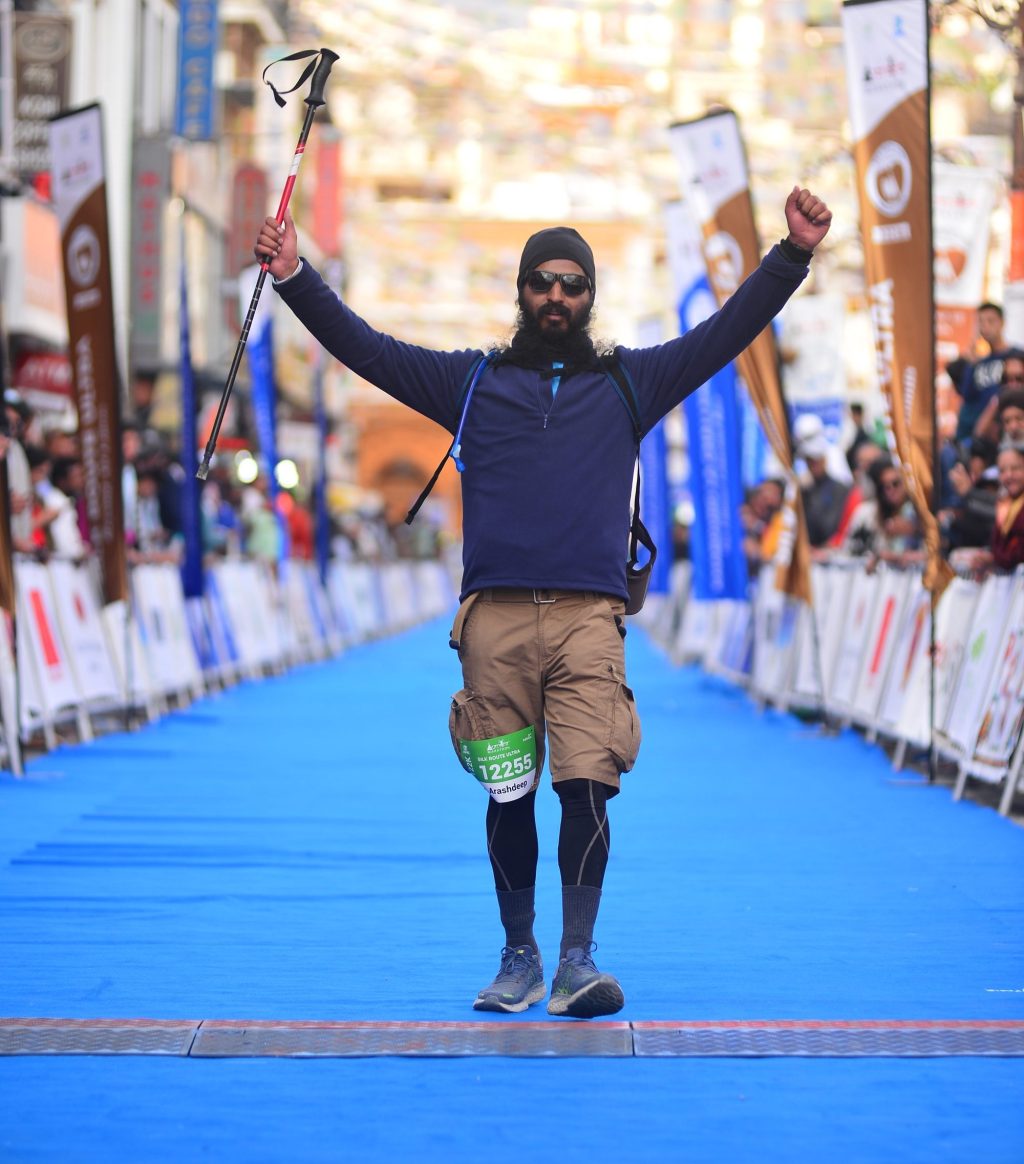
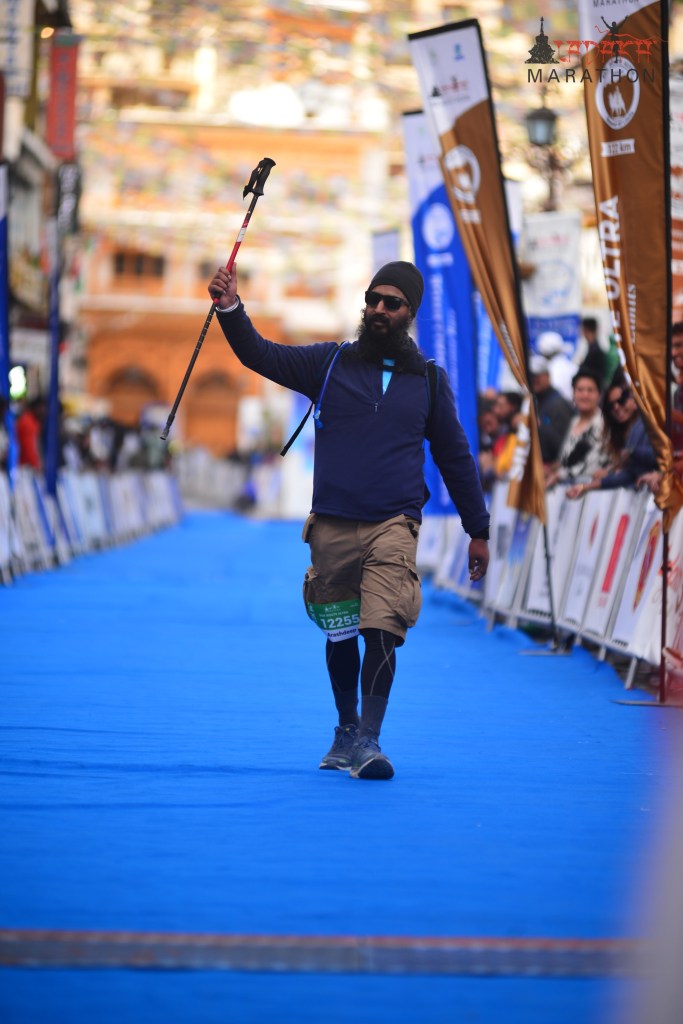
“Arashdeep! Great effort!” someone in the crowd shouted. The final 500m of the race! Two years ago, I arrived in Leh with no intention of running marathons. Today, I’m on the approach of completing one of the most difficult runs imaginable in these mountains.
Silk Route Ultra 122! Beyond all limits!
The finish line was crossed. The time stopped. I looked down. One single teardrop has just made the earth wet!
My pilgrimage was completed!
Nikomen!
Epilogue
As I finish writing this piece, a fortnight after the event, I’m certainly not as ecstatic as I was last year after the KC. SRU is a mental struggle that depletes you emotionally more than physically. I was never as physically exhausted as I was last year, but I feel the mental anguish I endured will take some time to heal.


 NIKOMEN!
Leave a reply to Sanjeevan Sharma Cancel reply