

Prologue
"Stagnation or blockage of the blood's circulation, whereby all motion and action of the spirit were (suddenly) taken away! It is impossible to cure a severe attack of apoplexy, and difficult to cure a mild one "
– Hippocrates
“A boy is being brought in unconscious, with pinpoint pupils!” – shouted the doctor from the nearby training centre.
“What happened?”- I asked.
“He was sitting outside in the sun for some time and suddenly collapsed after throwing a fit!”
“Heat Stroke?”
“Most likely!”
“Ok!”, I cut the call.
“Not again!” – I blabbered and rushed to ICU.
“This would be a third one in the last two weeks. The weather is gruelling hot and humid!” – the ICU nurse said.
“Hmm! We would sail through this time also!” – I acknowledged.
The initial chaos!
“The term Apoplexy (Greek: αποπληξία) is used to denote a disease in which the patient falls to the ground, often suddenly, and lies there without having their senses, or voluntary motion. Thus the inflicted persons who were instantaneously affected, as if struck by lightning, were named in antiquity as apopliktiki, attoniti and syderati".
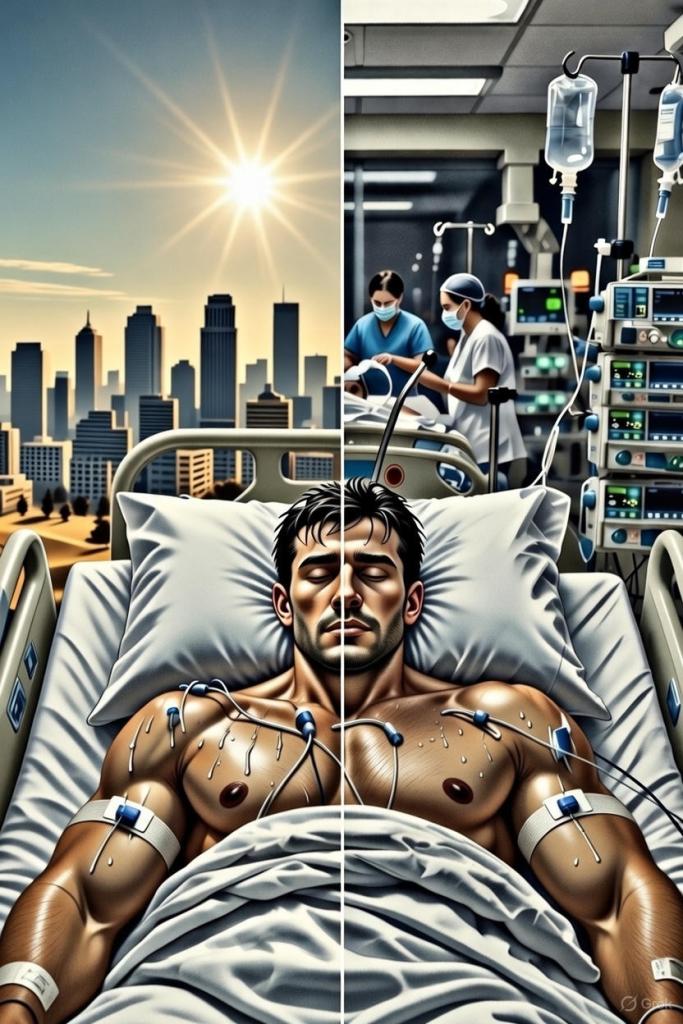
The young lad, in his 20s, was rushed to the ICU. He was confused, agitated, and moving restlessly in bed. He was drenched in secretions from his mouth and nose, as if a tap had been left open inside him. His arms were outstretched and twisted inward, teeth clenched – decerebrate posturing – brain was literally choking from high temperature and lack of oxygen.. He was also soiled with stool and urine.
The first look was enough to tell that he was in pulmonary oedema – his lungs were so full of fluid from leaky blood vessels that, without intervention, he would drown in his own secretions and die from lack of oxygen. The speed at which he had developed it was quite astonishing.
“What a mess this guy was in?” I wondered. He was filled with water everywhere except for where it was supposed to be in – blood vessels!
“But sunstroke gives no such warning. It strikes down its victim with his full armor on. Youth, health, and strength oppose no obstacle to its power; nay, it would seem, in some instances, to seek out such as these, as if boldly to flaunt its power, and in the very glare of day to deal its final blow.”
-Levick JJ, 1859
The Charge!
We put him on oxygen through a mask as his blood oxygen was dangerously low. Thin hollow tubes called IV cannula were inserted in his both arm veins and cold fluids rushed in to lower his core temperature. A tube was placed inside his stomach through the food pipe, which was full of undigested food. We kept clearing his secretions, but they seemed endless. His lungs still weren’t getting enough oxygen, so we decided to put him on a ventilator. It is a machine which delivers oxygen to a person’s lungs through a hollow tube (endotracheal tube) placed in the windpipe (trachea) till the time the person can breathe on his own. But it was very challenging since the airway was obscured by the excessive secretions, and he was moving constantly. The anaesthetist pulled in all her experience and somehow managed to secure the tube in his trachea.
There was excess fluid elsewhere, except in the blood vessels. He was dehydrated, and his kidneys produced almost no urine despite receiving litres of fluids. Had his kidneys given in? Then, a shot of a diuretic worked wonders! 150 ml- another 150 ml, and in no time, the urine bag was filled with a litre of urine. A sigh of relief! The kidneys were working – a small victory!
Lull in the battle!
After two hours of struggle, we gained some control of the situation. His temperature was down, the sedation calmed him, the kidneys were producing adequate urine, and his blood pressure and heart rate stabilized.
Yet, he was still getting just enough oxygen, even with 100% oxygen from the ventilator. For context, the air we breathe normally has only 21% oxygen. Notwithstanding, secretions from his lungs and stomach continued unabated. All kinds of questions were bombarding my mind.
“How much were his lungs damaged?”
“Aspiration?”
“Would he wake up from sedation?”
“Any permanent brain damage?”
Only time – and God – would tell! All we could do was wait and watch and hope the acute phase would pass. A long battle awaits. Overnight, the kidneys fought bravely, with a strong heart pouring in his soul with each beat praying for lungs to recover fast.
Day 2
“How is he doing?” his father asked me, looking at his son with a sinking heart.
“He is very critical! His lungs are filled with excess water, which is not helping him to breathe. We are supporting his lungs through this ventilator. It is pumping oxygen inside his lungs and helps him breathe till the time they recover on their own. But if this continues long enough, his other organs may not hold on,” I explained as gently as I could.
He continued looking at him. His only son is lying on a bed surrounded by all kinds of wires and tubes with one into his mouth. The continuous sounds of monitors and a ventilator were not helping either.
“He always wanted to serve in the army. It was his childhood dream. He would stand and salute whenever the national anthem played at the nearby school!”, he continued, eyes full of pain, he tried to hide behind a fading smile.
“He is just 25. He had worked so hard to get here. He is brave! He should come out of this. You can save him!”
All he wanted was a promise I couldn’t give. He wanted a hope to cling on, but I should not give him something which I could not afford! I did not say a word, but my heart was heavy. The days of his agony would be long, so would be mine.
A CT image revealed that more than half his lungs were filled with fluid. Worse, acidic stomach contents had entered his lungs, causing further damage. Stomach acid is vital for digestion, killing bacteria, and supporting many other bodily functions, all without harming the body itself. However, when it escapes to places it shouldn’t, like the oesophagus or lungs, it can cause significant damage. Heartburn occurs when acid irritates the oesophagus, which is not equipped to handle it. Similarly, if gastric contents reach the lungs, especially in unconscious patients, they can severely damage the delicate lung tissue.
He still needed 100% oxygen, even after 24 hours of ventilation. The worst fear was coming true. He had developed acute respiratory distress syndrome, a dreaded, difficult-to-treat complication.
“Stay strong, brother!”– I whispered, leaving the ICU for the day.
Day 3: Silver lining
We stopped sedation to assess his brain function. To our relief, he was fully awake and not agitated. I let the family see their son! They tried to talk to him, and all he could do was make a small forehead gesture in response. The doctor in me was reassured that his cortex was not badly affected after all. The family’s happiness was infectious. For a moment, there was joy. Was this the silver lining we were all waiting for? I wasn’t sure, because something was still not right.
The day moved on, the boy clinging to a thin rope, rather than the tube pushing oxygen into his lungs, with his kidneys and heart holding the fort, hoping for recovery. But for how long?
The lungs were not relenting. I got another CT scan done to look for any improvement. Nada!
Also read: Shamabi- With each death, a part of us also dies!
“I gave you my son heart and healthy, you return him to me in the same way”, his father pleaded. His mother was somber. The pain was palpable. How would they carry the burden of losing him, and how would I bear the weight of not being able to save him? Only God knew. The gloom within me was not something I wanted to share with them.
The final reckoning
I had not slept for three nights, hoping for a miracle. There were fleeting signs of hope – no fever for a few hours, a brief improvement in oxygen levels, only to be dashed soon after.
Today felt especially grim. Why was it so? I was not very sure of. He lay surrounded by tubes; the stable blood pressure on the monitor was our only solace. He had fought bravely, pushing his limits to the hilt.
Suddenly, his blood pressure dropped – 100/42, then 80/36 and he began to crash. We rushed fluids, put on noradrenaline, then vasopressin, then dobutamine. Within 30 min, he was on three medications to raise his blood pressure, but nothing was working. I couldn’t believe it was ending this way.





The inevitable was already there. We made a last-ditch effort to revive him, but he had already decided otherwise. In some time, his blood pressure vanished, and the ECG turned flat. He left us at 1851h.
I told his parents. His mother shouted at me. I don’t know why, but I just hugged her. She broke down. I was numb. I wanted to cry but couldn’t.
Did the boy betray us, or did we betray him? He tried 18 times to clear the exam for this course, only to be undone by his own body. He drowned in it! God can’t be crueller.
Epilogue: Coup de soleil
The word “Stroke” is derived from the Greek word “Apoplexy” which literally means being struck with a violent blow. Heat stroke is so named because the body’s temperature rises so rapidly that it overwhelms its ability to cool itself, damaging the brain, lungs, kidneys and other organs in a kind of nuclear chain reaction. It doesn’t discriminate between the ill and the healthy. Even the healthiest person can die within an hour if not treated promptly.
“First bleed as freely as the strength will admit; after this the legs, or if the disorder is violent, the whole body may be put into a warm bath, which should not be hotter than new cow's milk”.
– Medical Dictionary, 1775
Imagine suffering a heat stroke in that era, when treatment was bloodletting and putting warm water over the body. Medicine has advanced greatly, but a higher supreme power still humbles us. Doctors see life and death so often that we seem immune to emotions. My family often tells me that. Yet, with each death, God reminds us we are still human. With each death, a part of us also dies!
Know more about Heat Stroke:
- Cleveland Clinics: Heat Stroke: Symptoms, treatment, and prevention
- Ministry of Health and Family Welfare Guidelines: EMERGENCY COOLING FOR SEVERE HEAT RELATED ILLNESSES

 NIKOMEN!
Leave a comment